PTC acquisition: Schneider offers $205 cash, ending standalone AI push
$22.6B acquisition — $205 cash per share; 42.3% premium to last close
PTC’s acquisition by Schneider Electric delivers a $205-per-share cash exit, while shifting its industrial AI and product-lifecycle strategy under a larger platform.
PTC is in the middle of a strategic shift toward an “Intelligent Product Lifecycle”: connecting product design, engineering, service and operational data, while adding AI capabilities and reshaping its go-to-market model. Its latest product push centers on AI agents, connected tools and a product-data foundation for manufacturers. The standalone PTC story is now being replaced by a cash exit. Schneider Electric has agreed to acquire PTC, with PTC surviving as a wholly owned subsidiary if the deal closes. 〔0〕 The offer is $205 per share in cash, valuing PTC’s equity at approximately $22.6 billion and representing a 42.3% premium to the last closing price.
Deal metric
Terms
Cash consideration
$205 per share (Merger Consideration)
Equity value
Approximately $22.6 billion (Transaction terms)
Enterprise value
$23.7 billion (Transaction terms)
Premium to last close
42.3% (Transaction terms)
Premium to prior 30-trading-day VWAP
46.1% (Transaction terms)
Expected closing
Q3 2027, subject to conditions (Closing and next steps)
Termination fee payable by PTC
$700 million (Termination and Fees)
For shareholders, the immediate outcome is clearly better than the prior standalone assumption. There is no earnings-style consensus benchmark for this event, but the filing establishes a large cash premium to the unaffected trading reference points. The consideration is certain in form but not yet certain in completion: shareholder approval, antitrust and foreign-investment clearances, and other customary conditions remain outstanding.
Strategically, Schneider is buying the missing upstream layer of its industrial software stack. PTC brings CAD, product lifecycle, application lifecycle and service lifecycle software, while Schneider frames the combination as linking engineering intent with operational and energy data. That directly advances PTC’s existing AI-and-data strategy, but under Schneider’s broader industrial platform rather than through PTC’s independent execution. PTC’s filing describes more than 30,000 customers, €2.4 billion of CY25 revenue, an approximately 40% adjusted EBITA margin and roughly 10% expected annual revenue and ARR growth through 2029.
The headline synergy case is substantial but remains a buyer projection, not delivered performance. Schneider expects €250 million of annual run-rate cost synergies by Year 3 and approximately €800 million of revenue synergies, largely through cross-selling, broader distribution and combined AI-enabled software development. Those figures explain why Schneider is willing to pay a premium, but they are not yet realized benefits for PTC’s business.
The transaction also puts a hard boundary around PTC’s remaining strategic flexibility. The merger agreement restricts PTC from actively soliciting competing bids, gives Schneider a matching right in specified circumstances, and requires a $700 million termination fee if PTC exits for a superior offer or Schneider terminates after a board recommendation change. If completed, PTC will be delisted and deregistered, so the company’s independent public-market growth story ends rather than receiving another standalone operating update. 〔1〕
Bottom line: This is a major positive outcome for PTC shareholders versus the pre-deal standalone setup: a large all-cash premium and a credible strategic home for its industrial AI and product-data assets. The business impact is transformational, but completion still depends on the shareholder vote and regulatory process through the targeted Q3 2027 closing.่ง
What to watch next
PTC shareholder vote and regulatory clearances; closing targeted Q3 2027
It reads every public company's filing the second it drops — decoded into plain English, before it's a headline. The edge every investor deserves, not just the desks.
Trade the facts, not the FOMO.
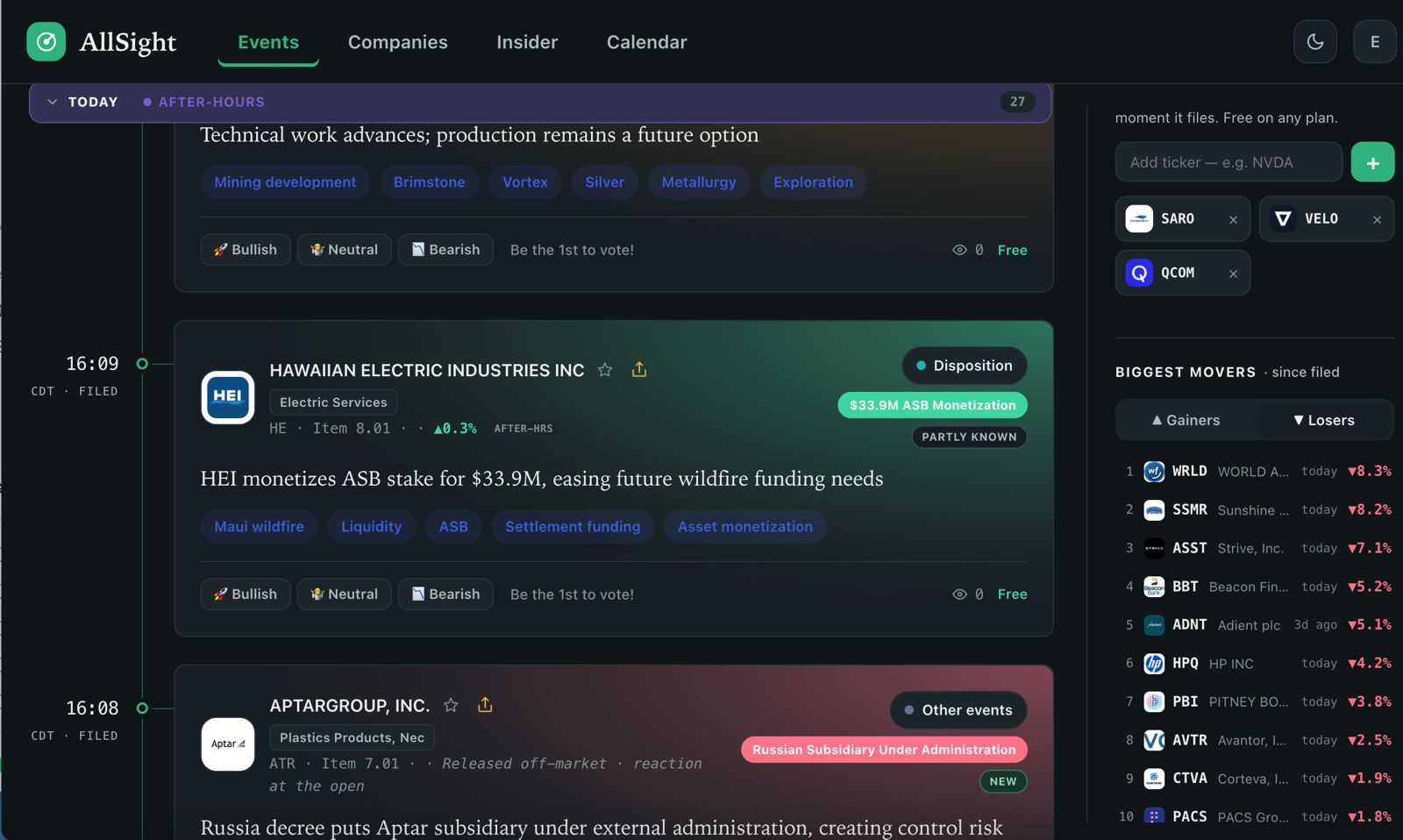
Every event
8-Ks decoded the moment they file
Every number
Fundamentals, valuation, quality
What's next
Earnings calendar + the analyst view
scroll ↓
From filing to your screen in seconds
AllSight is the fastest.
DETECT
The moment it files
Every public company, around the clock. The AI never blinks and never takes lunch — nothing to set up.
filed 9:41:03 · decoded 9:41:19
DECODE
Plain English — never a call.
The event, the numbers, how it sits vs. expectations — in seconds. The AI decodes it; you pull the trigger.
DELIVER
On your screen, before the bell
Overnight and premarket, it's already read everything. You walk into every session with the setup — not scrambling to find it.
Understand it like a Wall Street analyst. Explained like a friend.
Revenue $163.3M vs ~$144M expected; adjusted basic EPS $0.07 vs ~$0.04 consensus — a real upside surprise.Income statement
QNX revenue +27% to $80.3M; segment EBITDA $29.0M from $20.5M. “Record performance… core automotive.”Segment — QNX
Licensing jumped to $22.1M from $6.6M — it amplified the beat, but it's less recurring than QNX, so the quality sits in QNX.Segment — Licensing
FY27 guide lifted to $616–636M rev / $141–158M EBITDA, above the prior $594–621M / $119–139M framework.Guidance
QNX growth, margins, cash and a raised outlook all beat. But licensing amplified it and Secure Comms is flat — net retention 91% from 93%.Segment — Secure Comms
Know a company all the way down.
Not just one filing. AllSight profiles every public company end to end — the numbers, the quality, the insiders, the smart money, the Street. One page, nothing missed.
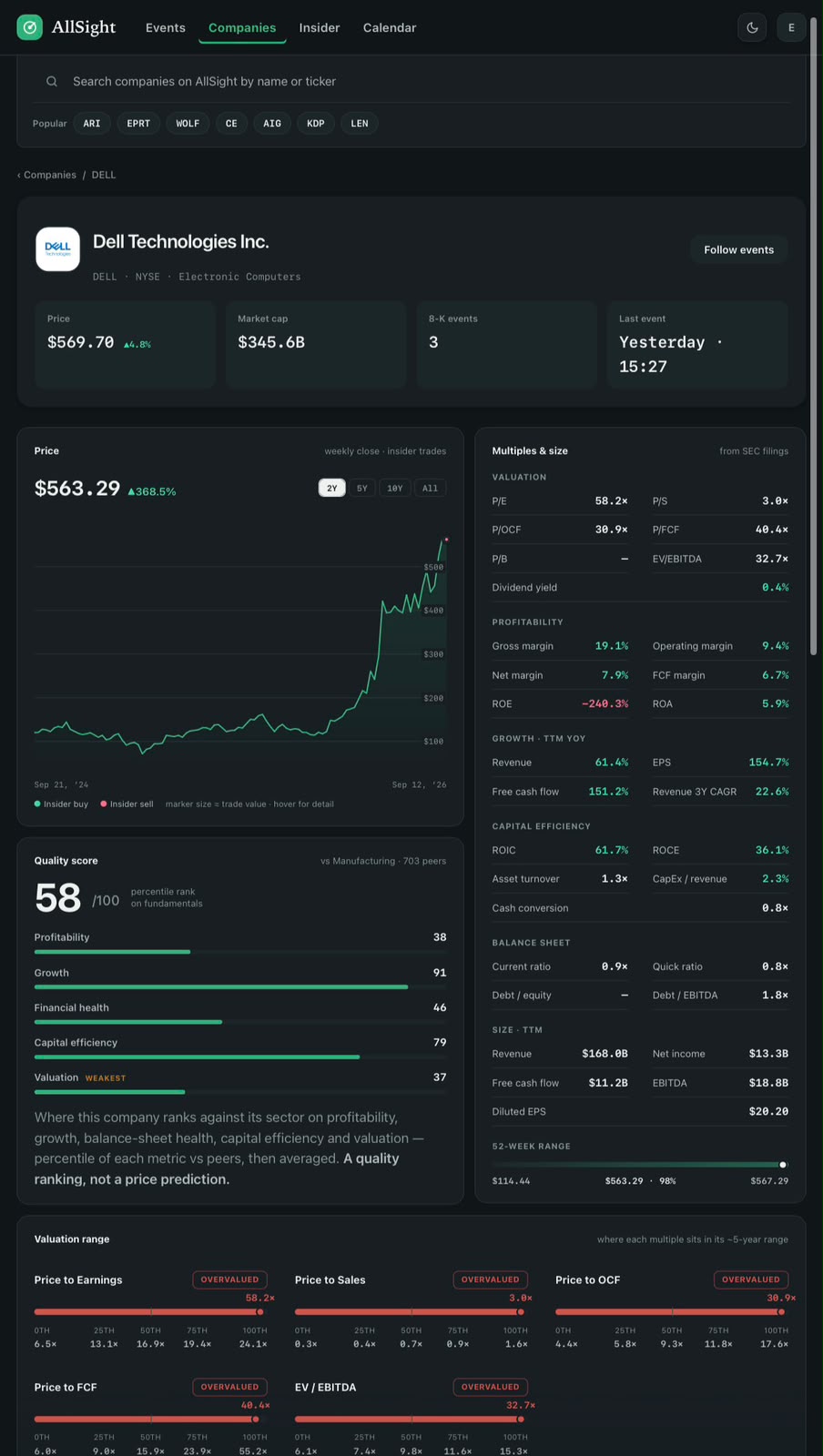
Price & every insider trade, plotted
A quality score ranked against every peer
40+ valuation & profitability multiples
Where each one sits in its 5-year range
Whole-market insider flow, in real time
Which superinvestors are holding it
Analyst consensus & price target
Live · — filings read this week
AllSight gives you an edge others can't.
One scan before the open, one after the close — every filing on every ticker, already decoded. You walk into every session fully prepared.
Not investment advice · a neutral translation you can check against the original SEC filing
allsight.ai
Breaking down Wall Street's information edge.
A buy-side analyst on every ticker — it reads every public company's filing the instant it drops and decodes it into plain English.
The Andersons — a record Renewables quarter that beat profit expectations
Filed Aug 3, 2026ANDE · NASDAQ
AllSight readBeatPriced in▲ 1.8% since filed · reaction agrees
adj. EPS $2.15 vs ~$1.48 consensus
This filing tests whether The Andersons' sharp profit increase reflects broad operating improvement or a one-off renewable-fuels boost. It also separates strong adjusted earnings and cash generation from the quarter's legal and impairment charges.
The quarter was substantially stronger than both last year and the published earnings expectation. Adjusted EPS reached $2.15, versus $0.24 a year earlier and above the published consensus of about $1.48; reported EPS was $1.65. Adjusted EBITDA more than doubled to $140 million, while sales slipped modestly — the improvement came from margins and operating performance rather than higher revenue. Financial Highlights · Statements of Operations
Q2 ($M, exc. per-share)
Q2 2026
Q2 2025
YoY
Sales & merchandising revenue
3,097.7
3,135.9
−1%
Net income (attributable)
56.6
7.9
+48.7
Diluted EPS
1.65
0.23
+1.42
Adjusted EPS
2.15
0.24
+1.91
Adjusted EBITDA
140.3
65.2
+75.1
Agribusiness adj. pretax
20.3
16.8
+3.5
Renewables adj. pretax
88.4
9.6
+78.8
Cash from operations
487.9
299.3
+188.6
Cash from ops (pre-WC)
112.9
42.9
+70.1
Renewables drove nearly all of the upside — the operating backdrop was strong, but the result also benefited materially from tax credits. Renewables' adjusted pretax income rose to $88 million on record production, stronger ethanol margins and merchandising gains. It also received $24 million of 45Z producer tax credits, so this was not solely a repeatable plant-margin improvement; the company did cite healthy export and domestic ethanol demand as supportive. Renewables — Record Q2 · Segment Data
Agribusiness improved, but it was a supporting contributor rather than the main earnings engine. Adjusted pretax income increased to $20 million as fertilizer margins improved and merchandising benefited from commodity-price volatility, despite lower fertilizer volumes. Agribusiness — Improved Q2 · Segment Data
Cash generation improved and funding capacity is comfortable, while reported earnings still absorbed meaningful non-core costs. Operating cash flow was $488 million ($113 million before working-capital changes); capital spending was $76 million. Adjusted EPS excludes $0.50 of legal-settlement, impairment and transaction items, so the $2.15 adjusted result runs ahead of the $1.65 reported. Leverage stays below the <2.5× debt-to-EBITDA target; no new quantified full-year outlook was given. Cash & Liquidity · Adjusted Net Income
Every company that filed a decoded 8-K in the last 3 trading days — size is market cap, color is the move since it filed (green up, red down), and each tile shows its latest event. Tap any to open it.
Reading the tape…
Move −+
Size market cap
Corner = time since it last filed · grey = reaction still developing
Upgrade to unlock high-value categories, whole market.
Email alerts
No tickers followed yet
Tap the ☆ on any card to build your watchlist.
Account
Passwordless sign-in
We email you a one-time code each time — nothing to remember.
Sign out
Log out of AllSight on this device.
Danger zone
Delete account
Permanently delete your account and all data.
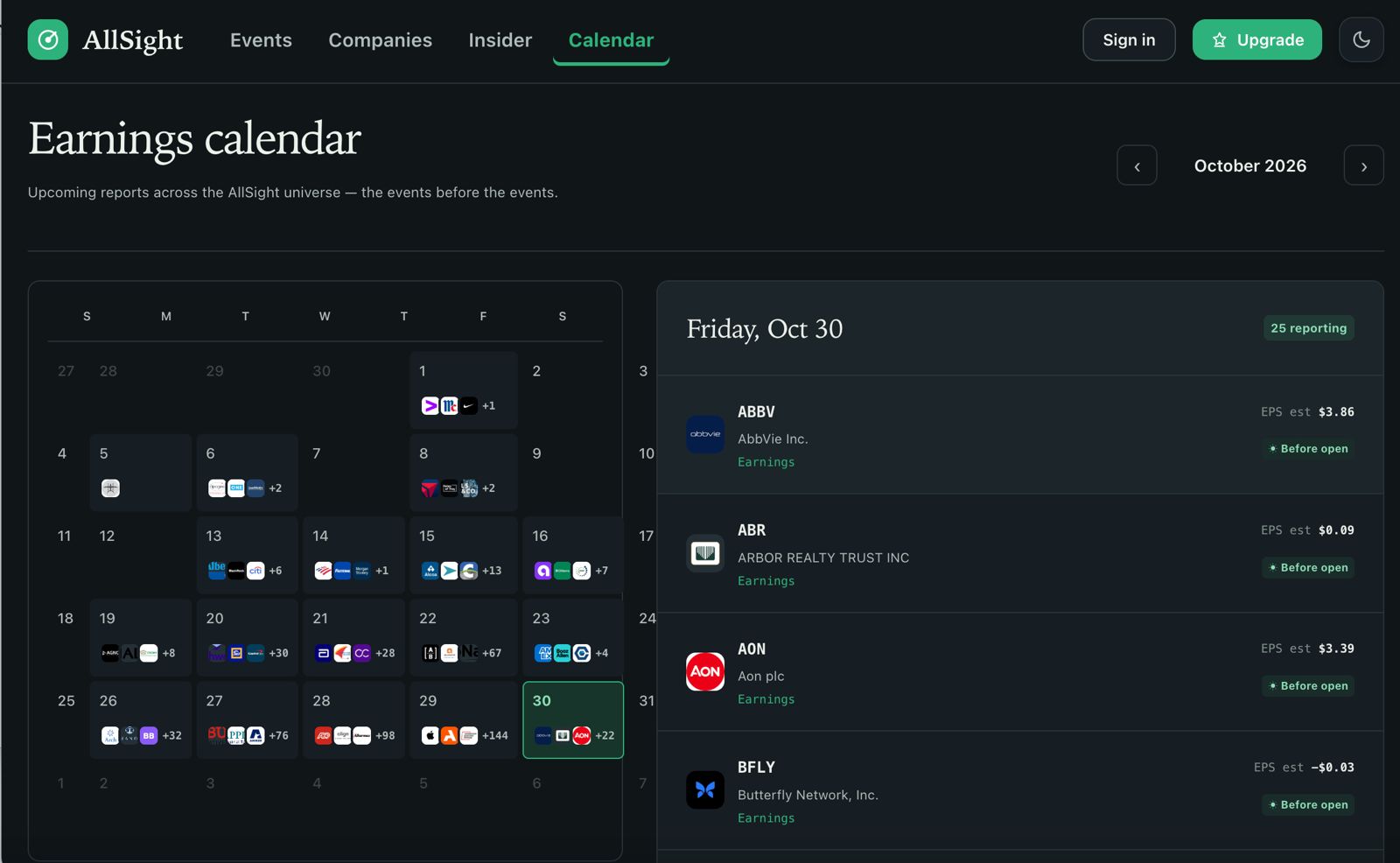
Earnings calendar
Upcoming reports across the AllSight universe — the events before the events.
—
Lining up the week…
Insider buys
Follow the smart money.
Corporate insiders buying their own company's stock on the open market, across the whole market. One row per company per day; planned 10b5-1 trades, grants, option exercises and buys under $25K are left out.
A buy-side analyst on every ticker — reading the whole market the second it moves.
It reads every public company's filing the instant it drops and hands you what it means — in plain English, before it's a headline.
The read itself
Not another feed. A buy-side analyst that never sleeps, on everything.
Whole-market breadthevery public company
Not the 20 names CNBC repeats. Every ticker that files — thousands of companies, one AI reading all of them.
Filed-to-decoded in secondsspeed
Filed 9:41:03, decoded 9:41:19. You've got the catalyst while the tape is still moving and the crowd's still on the headline.
Past the headlinedepth
What actually happened, the numbers that matter, how it sits vs what the Street expected, and what it sets up next.
Source-grounded & neutralrigor
Every read traces to the words in the actual filing — click to see them. A translation you can check, never a buy/sell call.
Zero effort to youconvenience
Plain English, one glance. Follow your stocks and the moment any of them files, it's in your pocket — no watching, no digging.
All of it, uncappedPro
Free gives you a taste — three reads a day. Pro takes the cap off: the whole market, all day, every day.
And then — go deeper
From "what happened" to "is it worth it."
Cheap or dear?Where it trades vs its own valuation history.
The quality score, in fullAll five dimensions, ranked against its sector.
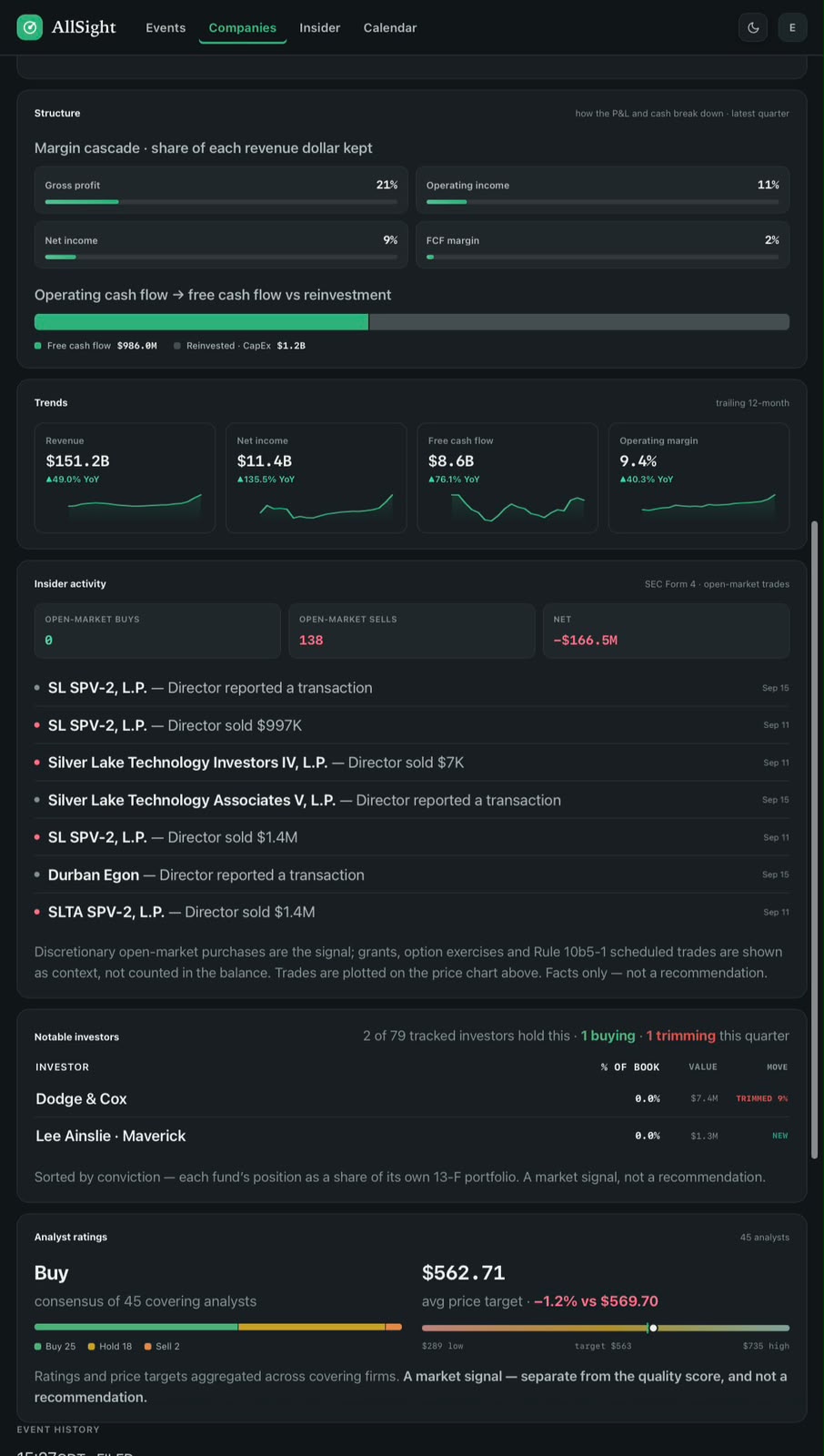
Structure & multi-year trendsRevenue, margins, cash — the hard numbers, decoded.
Insider activityWho inside the company is buying and selling.
Analyst price targetsWhere Wall Street says every name is headed.
The whole company, one pagePrice, ownership, the full read — on any ticker.
Hire your personal buy-side analyst.
Trade one usual slippage for a whole market's rhythm.
Free
$0
forever
Three decodes a day, on the whole market. The deep company read stays locked.
Monthly
$29/mo
billed monthly
Everything, uncapped — unlimited decodes and the full company read. Flexible, month to month.
Best value · save 40%
Annual
$17.40/mo
$209 billed yearly
about one slippage a month
Same full access — the whole market and every company, uncapped — at the lowest price. 40% off the monthly.
Billed today · cancel anytime. Powered by Stripe · AllSight never sees your card.
AllSight Premium
Wall Street reads it first. Not anymore.
A buy-side analyst on every ticker — the whole market decoded the second it moves, before it's a headline. Free gives you a taste. Pro takes the cap off and opens the full read on every company.
What Pro unlocks
Unlimited decodes — the whole market, all day, no 3-a-day cap
Is it cheap or dear? — where it trades vs its own valuation history
The quality score in full — all 5 dimensions ranked vs its sector
Financial structure & multi-year trends — the hard numbers, decoded
Insider activity — who inside the company is buying and selling
Analyst price targets — where Wall Street says every name is headed
Free
$0
3 decodes a day. The news, capped — and the deep company read stays locked.
Cancel anytime
Pro
$17.40/mo
No cap, full depth. Every filing decoded the second it drops — plus the whole company read: valuation, quality, insiders, analyst targets. Billed $209/yr · cancel anytime.
Cancel anytime · secure checkout · instant access
Straight from the 8-K
Verbatim from the filing AllSight decoded — highlighted above. Open on SEC EDGAR ↗
AllSight
Sign in to AllSight
Save tickers, get email alerts and upgrade — it starts with your email.
or
No password. We email you a 6-digit code. By continuing you agree to our Terms & Privacy.